Elk scoring and field judging
There are several ways to field judge elk. One is to “air judge” and the other is to actually estimate each measurement: mass, inside spread, point and main beam length.
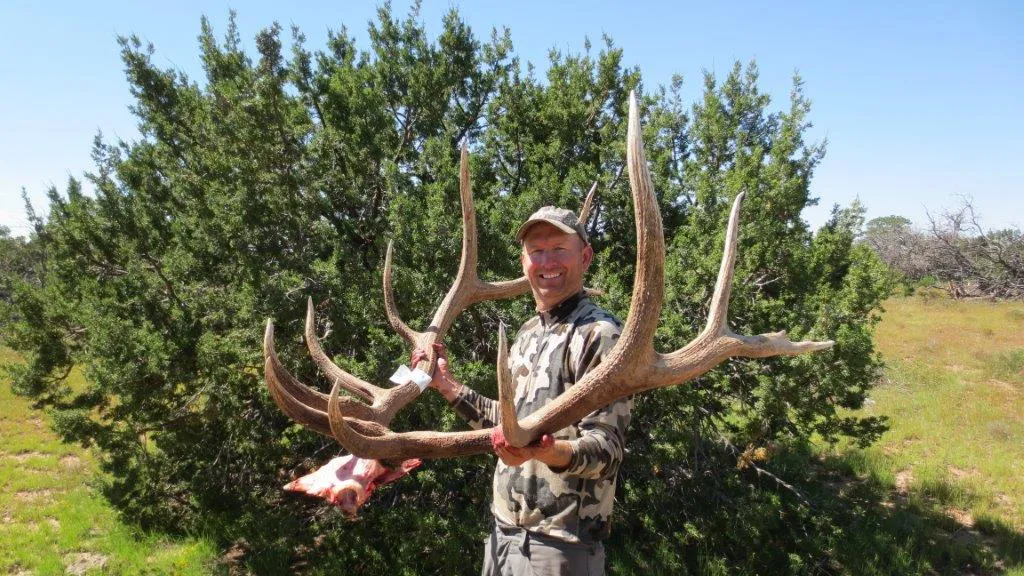
Air judging is the least accurate and is typically only used when you have just a few seconds or minutes to look over a bull. Estimating a bull's measurements allows you to really break down a bull, to ensure you are as accurate as you can be.
Estimating actual measurements
There are a few things that I like to do when trying to estimate the actual measurements on a bull elk. First, I use anatomical references to estimate several of the point lengths. I start by estimating the eyeguards (G1s and G2s), by seeing how close they are in comparison to the length of the burr to the tip of the bull's nose. If the first two points on each side follow parallel with the nose and tip up just at the end of the nose, they should be right around 16 inches. Beware of straight-looking points because they are often shorter than you think. Long eyeguards will follow the nose and then curl or bend upwards (look for at least 4 inches of curl for a 20-inch eyeguard). Once I determine the length of the first two points, I then extrapolate those into the rest of the points. The 3rd points (G3s) are often the source of a bull's weakness; again, look for a lot of curve.
| Measurement | Use it to judge | Inches |
|---|---|---|
| Head | ||
| Burr to tip of the nose | Eyeguards (G1s and G2s) | 15–16″ |
| Front of eye to tip of nose | – | 12–13″ |
| Inside of eye to inside of eye | – | 7–8″ |
| Ears | ||
| Tip of ear to tip of ear | Inside spread | 21–22″ |
| Base of ear to tip | Inside spread | 7–8″ |
| Body | ||
| Top of back to bottom of belly | 4th points (G4s) | 28–30″ |
| Shoulder hump straight down the leg | Main beams | 54–58″ |
Genetics and maturity come into play with anatomical features, so always compare a bull's body with other elk when possible.
Another anatomical measurement that can be used when determining point length is the distance from the top of the back to the bottom of the belly. That measurement is generally 30 inches. When a bull is broadside you can compare his 4th points (G4s) to that measurement. If the point is 10 inches shorter, then the bull probably has a 20-inch G4. Once you estimate the length of the 4th points, move on to the 5th points (G5s) and compare them with the 4th points. If they look about 6 inches shorter than the G4s, the bull has about 14-inch 5th points.
Next, I estimate the length of the main beams by using an important anatomical measurement. When a bull has his head down feeding, I determine whether the main beam is higher or lower than the hump on his back above his shoulder. The distance from his top shoulder hump down his front leg to his hoof is generally 54 to 58 inches, depending on the maturity (and genetics) of the bull. If the tip of the main beam comes to the top of the hump then the beam is probably around 50 inches. If it is shorter or longer than the hump on the back, I add or subtract inches accordingly.
Determining the 4 mass measurements per side is usually difficult, so I use a rule of thumb. If the rack doesn't look heavy and has a thin appearance, I attribute 27 inches of mass per side, or 54 inches total. If a bull looks really heavy and solid, then I estimate about 30 inches of mass per side. Trying to determine mass is very hard and requires scoring a lot of racks, but if you use those numbers you will often be close.
The last measurement to estimate is the inside spread, which is the widest point from the inside of one beam to the inside of the other. I often use 2 anatomical measurements: first, the distance from ear tip to ear tip, and second, the actual ear length itself. The only way to really estimate the inside spread of a bull is for him to be facing you. When he's facing you, look at the width of his ears. If you can add one ear's length to each side, that should put you at a 37-inch inside spread. If you can add an ear and a half, then the inside spread measures 44.5 inches. Keep in mind that very few bulls are wider than 45 inches.
There is quite a bit of “air judging” that gets done while estimating measurements, but if you use anatomical references, you can often get pretty close to the real measurements. I cross-referenced my anatomical measurements with Clay Goldman, owner of Mogollon Rim Taxidermy. I would suggest you look for a taxidermist near the area or in the state you are hunting and ask for their expert advice on these features of the bull elk in those areas.
Magic number / ESP
There is a great shortcut for field judging bulls where I use anatomical references, but instead of trying to estimate each measurement individually, I use a magic number for the main beam length, mass and inside spread, and then I compare the length of the points from one side to the other and estimate the shortest points (ESP). This method is not quite as exact as estimating each measurement, but it gets you very close and it's much quicker and easier.
First, I will start with the magic number of 200. For a mature typical bull elk that scores around 350 inches, his main beam length is usually around 50 inches per side × 2 sides = 100 inches, his mass usually equals 30 inches per side × 2 sides = 60 inches, and inside spread is usually around 40 inches, so 100 + 60 + 40 = 200.
Total350″ gross
Next, I estimate the length of the shortest point for each antler, double it, and then add them up. Be careful with these estimates because whenever you double a measurement, it can make your score go up or down drastically. Do your best not to overestimate your shortest points. Now add the total length of points to the magic number of 200 to get the gross score. Finally, go back to the main beam, mass and inside spread in order to further review. Is the main beam really 50 or is it 53 inches? Is the mass heavy or light? Is the bull really 40 inches inside or is he 36 inches? If you think those measurements deviate from the magic number, just add or subtract the differences accordingly.
Elk field judging tips
- Try to always be conservative when judging a bull.
- Tine length is the single most important aspect of a bull's score. Long points are everything!
- Look for any weaknesses such as short points, beams or weak mass. They can reduce a bull's score in a hurry.
- Inline, non-typical and/or extra points can dramatically increase the gross score.
- Count the number of points on each side, because if something looks odd, it usually is.
- Look for good spacing between the points. If the points on the main beam look close together then the beam is probably shorter than you think.
- If a beam or point looks straight, then it will be shorter than you think. Lots of belly or curve in the points and the main beam means greater length.
- The main beam length from burr to fourth point is usually 30 inches, so compare that to the length of the main beam from the fourth point to the tip of the beam. If it looks like it is about half as long (15 inches), then the total length is 45 inches. If it looks equally as long, then it is 60 inches.
- Digiscoping is a must while scouting! Live video and images will help you get to the next level. See my digiscoping setup.
- Main beam50 → 60+
- Inside spread37 → 45+
- Mass per side27 → 32+
Main beams rarely reach 60″, inside spread is rarely over 45″, and mass is rarely over 32″ per side.
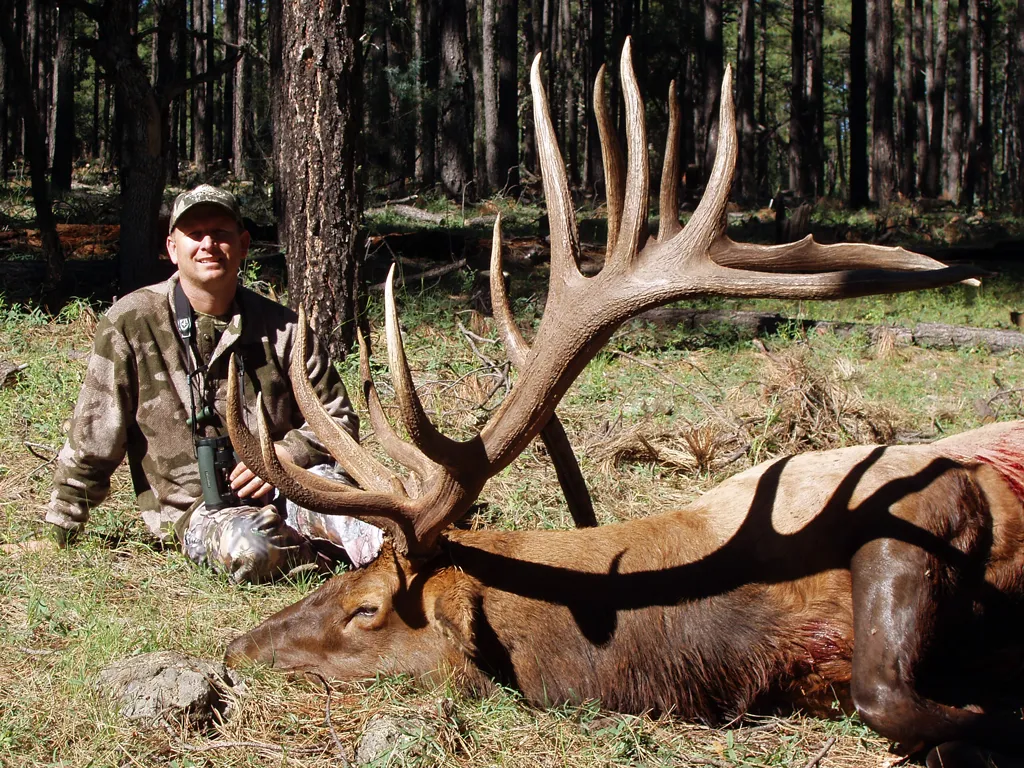
Field judging elk is an art, while scoring a dead elk is a science. One of the best ways to improve your field judging skills is to practice field judging bulls before measuring them. Experience is everything, so the more you can see, film, take pictures of and put your hands on bull elk, the better you will get.
I hope these tips, videos and diagrams come in handy when you are trying to field judge bulls, but please remember, it's more important to measure your hunt success by the memories and quality experiences gained, rather than in just inches.
Watch: Jay's elk scoring videos
Scoring an elk antler
6 videosField judging and scoring elk
7 videosGuess the score
15 videosListen: field judging elk on the podcast
- How to field judge elk, part 1
With Craig Steele of Exclusive Pursuit Outfitters: “air judging,” using anatomical references and ways to be more accurate in field judging elk while hunting.
0:001:12:49 - How to field judge elk, part 2
With Craig Steele: estimating actual measurements and ways to be more accurate in field judging elk while hunting.
0:001:29:58 - Field judging elk
Three methods: how to “air judge,” the estimating actual points method and the estimating shortest points method, with several scoring examples.
0:0052:14 - Field judging and scoring elk
Jay Scott and Craig Steele discuss field judging and scoring elk.
0:002:00:08
Subscribe to the Jay Scott Outdoors podcast
Elk scoring resources
- How to score and field judge elk, Part 1goHUNT
- How to score and field judge elk, Part 2goHUNT
- Typical and non-typical elk score chartsFree PDFs from the Boone and Crockett Club
- Jay's past field judging elk photos, articles and contentJay's blog