Bighorn Sheep scoring and field judging
Unlike deer and elk, bighorn rams start growing their horns at birth and keep growing them their whole lives. They never shed them.

Unlike ungulates (deer and elk), Bighorn Sheep rams start growing their horns at birth and continue to grow their horns throughout their lifespan. They do not shed their horns like ungulates shed antlers. Instead, their horns grow until the animal dies. Within each horn there is a living core that provides a continuous flow of blood beneath the hard sheath. The horns are made of keratin, which is the same material that fingernails and hooves are made of, and is a fast-growing substance.
Rams' horns typically grow tremendously until the ram gets old and fully mature. At this point, the horn growth slows down quite a bit. Yet, as the ram becomes fully mature, the horns grow more in mass, becoming thicker. As bighorn rams age and go through the summer and winter, a growth ring is created. For each year that passes, a ring is reflected in a ram's horn; these are often referred to as “growth rings” or “annuli rings.”
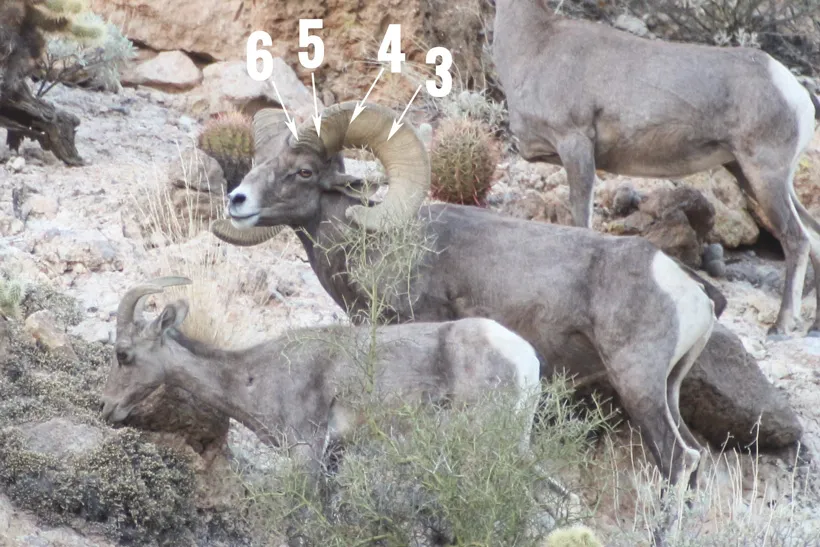
The ring is created when the animal is under stress, which is usually caused by rutting or mating rituals, when they are not thinking about feeding and maintaining their nutrition, but only trying to breed. For desert bighorns, the ring is created in the summer; for Rocky Mountain bighorns, the ring is created in the winter. These seasonal rings directly correspond with their respective mating seasons. The first part of the horn that a ram grows is called a “lamb tip,” which usually gets broomed off as the ram's life continues. Brooming occurs when a ram rubs, wears or knocks off the end of his horn from eating, fighting and rubbing.
It is extremely important to take older age class rams, but for the sake of keeping this page to scoring and field judging, I am going to refer you to an in-depth article on how to age Bighorn Sheep.
How to score Bighorn Sheep
To keep it simple, there are four mass measurements for each horn, which are the circumferences around the horn (8 total), and one length for each horn (2 total). The first step is to measure the lengths of each horn. Next, determine where each mass measurement needs to be taken based on the length of the longest horn.
Take the length of the longest horn and divide it by four. Let's use a 36″ horn as our longest horn, so 36 divided by four equals 9″. Based on this example, there will be a measurement taken at 0 (the base), or D1; at 9″, or D2; at 18″, or D3; and at 27″, or D4. The first mass measurement is always taken at the base of the horn where it meets the head, which is called the “D1” measurement on the Boone and Crockett (B&C) score sheet. Then, you continue 9″ down the length of the horn to the second measurement, and so on for the third and fourth.
One thing that confused me when I was first learning how to score sheep is figuring out what and where these quarters actually were. In essence, what they are talking about is D2, D3 and D4, but in sheep lingo, those measurements are referred to as the base, first quarter, second quarter and third quarter.
In order to calculate one side or one horn total, first add the mass of each side and the horn length of each side. Then, add both horn totals together for the gross, or total, score. Once that is done, compare each mass measurement to the other horn and deduct the difference to get the final net score. You do not deduct horn length, only each circumference measurement.
Scoring tips
- Spread is measured for the B&C scoring system, but does not factor into the score.
- The length of the horn is measured from the lowest point in front on the outer curve to a point in line with the tip. Do not press the tape into depressions. The low point of the outer curve of the horn is considered to be the low point of the frontal portion of the horn, situated above and slightly medial to the eye socket (not the outside edge). Use a straight edge, perpendicular to the horn axis, to end the measurement on broomed horns.
- The circumference of the base is measured at a right angle to the axis of the horn. Do not follow the irregular edge of the horn; the line of measurement must be entirely on horn material.
- Divide the measurement of the longer horn by four. Starting at the base, mark both horns at these quarters (even though the other horn is shorter) and measure the circumferences at these marks, with measurements taken at right angles to the horn axis.
- Try to resist the urge to score the ram at the harvest site while the hair is still on the head. It is hard to get an accurate reading and often leads to a score bigger than the actual score, which can make for awkwardness.
Field judging Bighorn Sheep
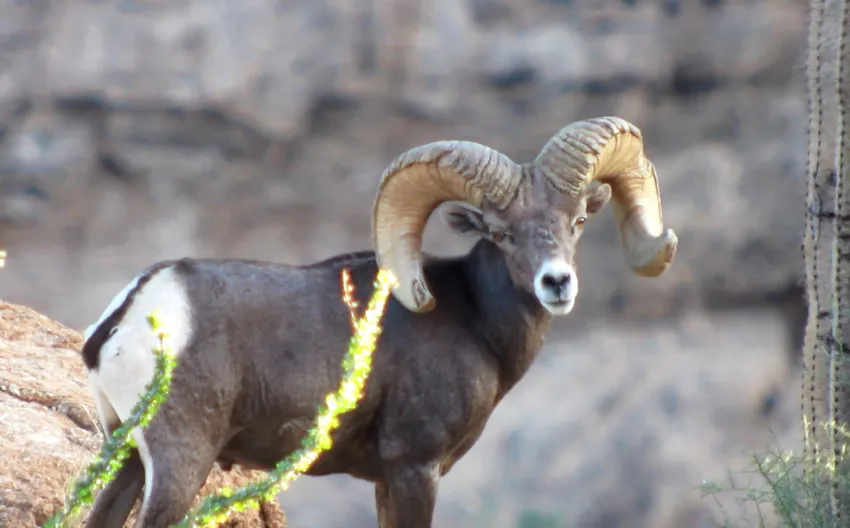
When field judging Bighorn Sheep, the first view to look for is the head-on view; then, look at the side profile of each horn. In the head-on view, look for the horn configuration to be like a square box with the bottom of the horns below the jaw. Horns should go up off the top of the head, not straight back. As the horn curls up, this is where the side view becomes important. Horns should go up and then back away from the skull as much as possible before they drop downwards to create the most length. You want the horns to drop down as far as possible. That drop creates a deep curl. Look for horns that tip up toward and past the nose as much as possible. The mass should look “puffy” and fat throughout the whole horn, all the way to the tips.
Each bighorn has a different body size and characteristics, which is an important part of determining the size of their horns while in the field. It is very important to make sure that the ram you are evaluating is with other sheep so you can analyze his body size compared to his wild counterparts. Some rams may look impressive standing alone yet blend in when with a group of rams. It's important to be able to spot the difference.
The first step to field judging rams is to get familiar with other rams that have been harvested in your unit or area. Gather all of the data that is available from sources like goHUNT INSIDER and local game and fish departments. This will provide an accurate assessment of the base sizes of previous rams that have been harvested, which you need for comparison when you see a big mature ram in the field. Try not to assume that the ram you are looking at has bigger than average bases. If you use the average base size as a baseline and then estimate the remaining measurements from there, you will be more accurate. Store the data gathered on your phone so you have it in the field. Try to analyze every Bighorn Sheep photo that you can get your hands on. When you are in the field, you can evaluate the ram you are looking at against the data and photos on your phone. Use technology to your advantage.
Mass
Mass accounts for approximately 60% of the total score on a mature desert or Rocky Mountain bighorn ram. Most of the desert rams that hit the high 160s will have approximately 100″ of mass. Most rams that have 100″ of mass have roughly a 15″ base. When you get into 15½″ to 16″ bases, you can get up to 105″ or 106″ of mass, depending on the second and third quarter measurements. Mass beyond that is very rare. Some of the biggest Desert Bighorn rams that I know of have 110″ of mass and scored around 185″. Adding a rough mass estimate to the two horn lengths gives you a representative score much more simply and quickly than trying to guess every measurement.
Total≈ 167″ gross
| Base | Total mass, about |
|---|---|
| 15″ | 100″ |
| 15½″ to 16″ | 105–106″ |
| The biggest rams Jay knows of | 110″ (scored around 185″) |
For a ram to be a real high scorer, the mass needs to carry all the way through the horn, past the third quarter measurement. One thing to note is the importance of keeping track of a ram's mass per side.
Quick method for field judging mass
A good rule of thumb is to judge the bases and then use this formula: minus one, two and six. For example, if a ram has a 15″ base, subtract one for the first quarter measurement, so it becomes 14″; then subtract two for the second quarter measurement, so it becomes 13″; then subtract six for the third quarter measurement, so it becomes 9″. That would give the ram 15″, 14″, 13″ and 9″, totaling 51″ of mass. I have found this to be fairly accurate.
Length of horn
A good solid Desert Bighorn ram (164″ to 168″) will have 33″ or 34″ horns, a big ram (166″ to 170″) will have 35″ or 36″ horns and really big rams (170″+) will hit 37″ or 38″. Anything bigger than that will look ridiculous. Mature rams will rarely have horns under 30″ unless they're broken or severely broomed. Look at the horn drop, at how far the horns come off the head (side to side), how far up and back they come out of the bases, whether the tips turn up, and the amount of brooming. Looking at a bunch of rams helps when it comes to determining horn length.
- Good solid ram (164–168″)33–34″
- Big ram (166–170″)35–36″
- Really big ram (170″+)37–38″
Mature rams rarely have horns under 30″ unless broken or severely broomed.
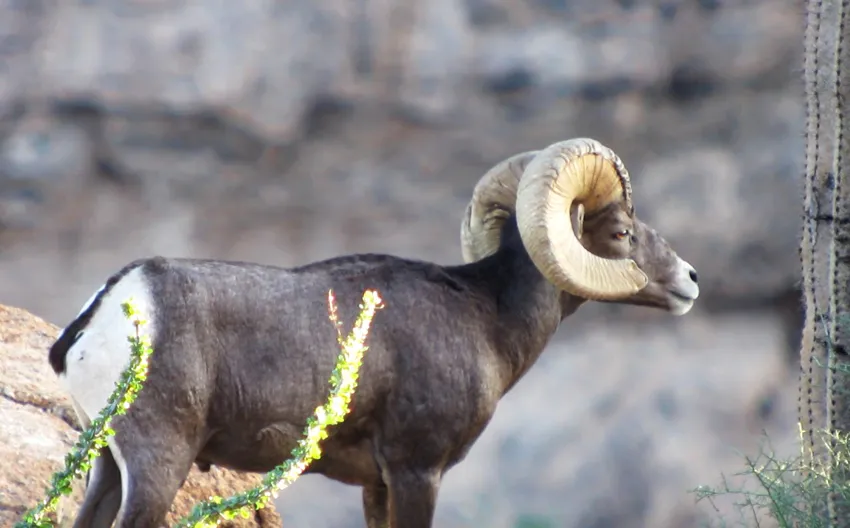
When you look at a ram from the side, the larger the hole, the longer the horn. Look at the circle and determine if you can fit a baseball, softball or soccer ball in the inner hole. From the side, if the lower edge of the horn comes down to the bottom of the jaw and the horn tips come up even with the bridge of the nose, the horns are longer than normal. The one thing that I look for that makes a ram exceptional is horn drop. I have found that if the whole horn drops below the jaw line, you have an exceptional ram nearly every time. But be careful when using this indicator, since you can also be fooled by drop if the horn lays really flat on the ram's head. Ideally, you want a horn to come high off the head and then back and drop real low below the jaw.
Jay's tips for field judging a ram
- Be careful of rams that are standing alone and not with other sheep. They can be deceiving. Sometimes they look big alone, but once they are part of a group of sheep, they become average.
- If you overjudge the bases and then base all of your measurement estimations on this overjudgment, the ram can shrink real fast. Try to be as accurate as possible on your base estimation.
- The first quarter measurement will usually be within a half inch of his base measurement.
- Be very careful of tight-curled rams. They tend to be short on horn length. Tight-curled rams usually look heavier than they actually are.
- Big rams almost always look giant from every angle. If you have a weak angle, then it is probably not a giant.
- Look for rams with a large curl depth. Usually those rams score much higher than tightly curled rams.
- Nelsoni desert rams can be difficult to judge because they usually have lots of flare and, from the side, it is hard to estimate length. Keep in mind that usually more flare means a longer horn, which is good for score.
- Width is measured for submitting a B&C entry, but does not actually count in the score calculation.
- Because judging body size is so important, remember that big rams' butts will discolor and have a dingy look. The white patch on the butt will get really off-colored. They will usually have a big pot belly and a swayed back.
Watch: Jay's Bighorn Sheep videos
How to field judge and score desert bighorn sheep
3 videosListen: field judging Desert Bighorn Sheep
- Desert bighorn sheep hunting, field judging, aging and scoring
With Craig Steele of Exclusive Pursuit Outfitters: desert bighorn sheep hunting tactics, field judging, aging and scoring.
0:001:16:14 - Desert bighorn sheep hunting, field judging and aging rams
Jay Scott and Craig Steele talk bighorn sheep hunting in Arizona.
0:001:07:51 - Field judging and aging desert bighorn sheep
Jay Scott talks with Craig Steele about field judging and aging desert bighorn sheep.
0:001:11:01
Subscribe to the Jay Scott Outdoors podcast
Field judging Bighorn Sheep resources
- Become an expert at field judging Bighorn SheepgoHUNT
- How to accurately score Bighorn Sheep hornsgoHUNT
- Bighorn Sheep score chartFree PDF from the Boone and Crockett Club
- Jay's past field judging Bighorn Sheep images, videos and contentJay's blog